
History of Place
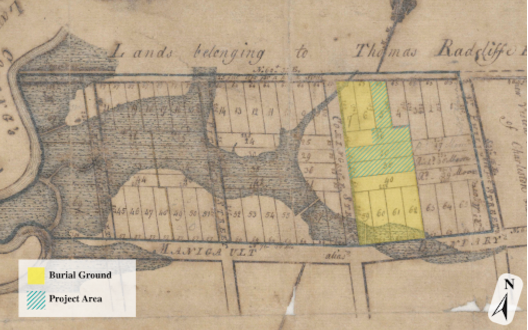
The Coming Street property is part of a landscape with a long and layered history. Before its current use, this area was located on the edge of early Charleston, in a low-lying environment shaped by marshland and waterways.
In 1793, the City of Charleston purchased this land to establish a new public burial ground. Active between the 1790s and 1807, the burial ground served as a final resting place for many of the city’s most vulnerable residents.
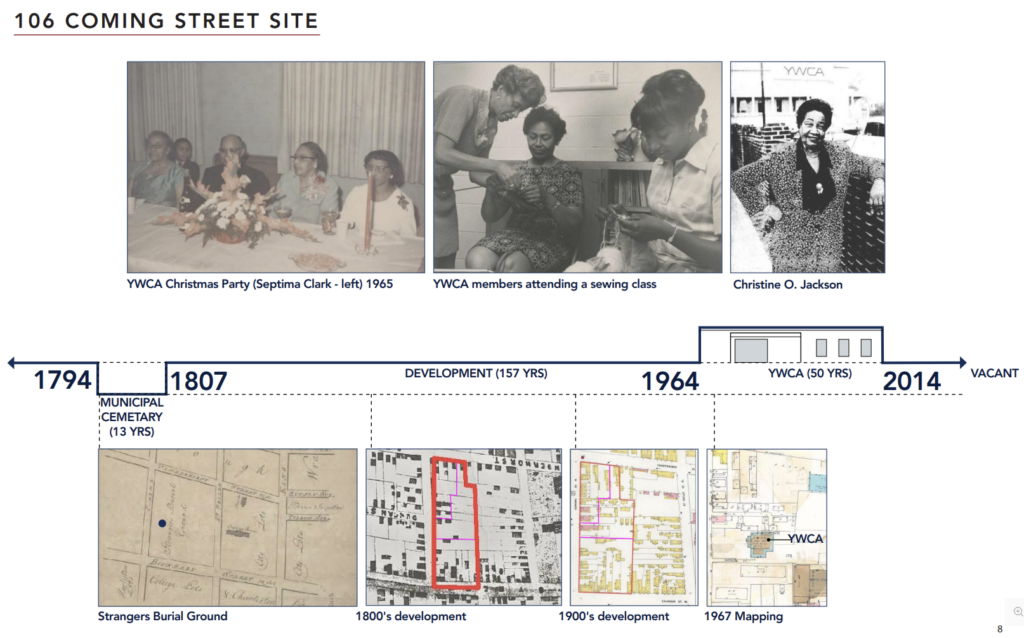
Image Details:
Historical timeline titled “106 Coming Street Site” showing the site’s evolution from 1794 to 2014. The site begins as a municipal cemetery (1794–1807), transitions through 157 years of development (1807–1964), and serves as the YWCA from 1964 to 2014, after which it is labeled vacant. Image courtesy of: Liollio Architecture.
Public burial grounds of this period often served individuals who lacked access to private family plots or church cemeteries. In many cases, burials occurred with limited resources and without permanent markers, reflecting broader social inequalities present in Charleston during this era.
“In August of 1794, City Council declared it “necessary” to designate an additional place for the burial of “strangers, those who may die in the poor house, hospitals, and negroes”” (-BVL Historic Preservation Research) (Include BVL Report Figure 5 image – page 5).
Historical records refer to the site as the “Strangers and Negroes Burying Ground”. These people interred included enslaved people, free people of color, immigrants, sailors, and individuals who died in institutions such as the Poor House, City Hospital, and Orphan House.
“In November of 1798,…a committee representing several of Charleston’s churches called for the designation of a burial site “for the internment of Strangers” outside the city’s limits with a separate section “for the burial of negroes, other people of color, and slaves.” ( “For the Information of the Citizens,” 1799 May 3, City Gazette and Charleston Daily Advertiser, Charleston, SC. – Tulla, Crossan, Metze 2025).
The burial ground was used during a period marked by rapid population growth, recurring disease outbreaks, and the final years of the Transatlantic Slave Trade. Many of those buried here lived and died under conditions shaped by inequality, displacement, and limited access to care.
In the decades after the burial ground closed in 1807, the property was gradually subdivided and redeveloped for housing, and its earlier use was no longer widely recognized. By the early twentieth century, the site had become home to the Coming Street YWCA, an institution founded in 1907 to support Black women and girls in Charleston.
In 1964 a new YWCA was built and the site served as an important space for civic organizing, education, and Black community leadership, offering educational programs, social services, and a gathering space for civic life. During the Civil Rights era, the site served as an important space for civic organizing, education, and Black community leadership. The current building remained in use by the YWCA until it was sold in 2014.
Today, the history of this place is being revisited through research and community engagement. Understanding this history is an important part of informing how the site is approached and cared for moving forward.
Ethical Stewardship
This site is understood as a place of burial, and therefore a place that requires care, respect, and thoughtful decision-making.
Ethical stewardship principles
The approach to stewardship is informed by established ethical guidelines in archaeology and historic preservation. These include principles that emphasize:
- The approach to stewardship is informed by established ethical guidelines in archaeology and heritage practice. These include principles that emphasize:
- Making research and decisions transparent and accessible
- Respect for human remains
- The importance of involving descendant and affected communities
- Avoiding and mitigating harm wherever possible
These principles are reflected in international and professional guidelines, as well as in ongoing conversations with local communities. These include frameworks developed by UNESCO, the United Nations, the World Archaeological Congress, and leading archaeological and cultural organizations, such as the Society for American Archaeology, American Association of Biological Anthropologists.
Because this burial ground does not have clearly identifiable individual lineal descendants in the historical record, engagement focuses on collective descendant communities, communities of care, and the broader public.
Dignity to the deceased
This site is understood first and foremost as a place of burial. The individuals interred here were members of Charleston’s most vulnerable communities.
Many were likely buried without markers, and their names and identities were not recorded or have not survived. As a result, their presence has remained largely unrecognized in the landscape.
Treating this site with dignity means acknowledging that these were individuals with lives, relationships, and histories. It also means approaching any work on the site with care, respect, and an awareness of the historical conditions, such as poverty, disease, and the Transatlantic Slave Trade, that shaped their lives and deaths.
The individuals buried at this site likely came from diverse cultural and religious backgrounds, including African and indigenous spiritual traditions, Christian, Muslim, and other belief systems present in Charleston during this period.
Because of this, there is no single set of practices that can fully account for how all those buried here would have understood death, burial, or remembrance. This complexity is one reason why multiple community perspectives are important in considering how the site is treated.
In archaeological practice, dignity to the deceased includes careful handling of any human remains, clear communication, and a commitment to ensuring that those buried here are not overlooked or forgotten in decisions about the future of the site.
Understanding Communities
This project recognizes that different communities may have meaningful connections to the Coming Street property. In reality, communities are fluid and overlapping. The terms used on this website are not determinative; they are used to describe relationships to the site and generally correspond to categories used in the project’s community engagement framework.
Communities of Origin are groups whose ancestors were directly connected to the burial ground through shared historical, cultural, or geographic ties.
In the context of the Coming Street site, this includes African American communities descended from enslaved and free Black individuals who lived and died in Charleston. It also includes people of European descent whose ancestors may have died at city institutions, or those who were unaffiliated with a religious cemetery. Native American communities also have historical connections to this landscape and region. Where appropriate, Tribal Nations may be engaged separately through Tribal Consultation protocols.
These communities are understood to have the deepest relationships to the individuals buried at the site, even when specific lineal descendants cannot be identified.
Collective Descendant Communities are groups who share a broader historical or cultural connection to those buried at the site.
Because the burial ground is municipal and dates to a period when records are incomplete or absent, particularly for marginalized populations, descendant relationships are often understood collectively rather than individually.
This concept recognizes that the legacy of enslavement, displacement, and exclusion has made it difficult to identify specific descendants, while affirming that connections to the site remain meaningful and valid.
Communities of Care are individuals and groups who may not be descended from those buried at the site, but who have a demonstrated commitment to its respectful treatment, preservation, and interpretation.
This may include local residents, faith leaders, cultural organizations, scholars, students, and others who are invested in the ethical stewardship of the site.
These communities play an important role in supporting dialogue, contributing knowledge, and helping ensure that key decisions are made with care and accountability.
These categories are not static or exclusive. Individuals may identify with more than one, and all are important to the ongoing process of understanding and stewarding this site.