
PROCESS AND TRANSPARENCY
Project values
- Respect for the dignity of those buried at the site
- Transparency about what is known, unknown, and still being determined
- Ongoing engagement with community members and stakeholders
- Careful stewardship of a historically significant place
- A commitment to learning from the past and improving how key decisions are made.
Project Process & Timeline:
The project is being approached in phases. Several phases include required review periods and consultation with regulatory agencies before work can continue. While phases follow a general sequence, community engagement and evaluation are ongoing throughout.
Phase 1 – Historical Research
- View the Coming Street YWCA Historic Report by BVL HPR
- View the Public Burial Ground Report by BVL HPR.
- Additional sources to reference include The Forgotten Dead: Charleston’s Public Cemeteries, 1794–2021 by Nic Butler, Ph.D.
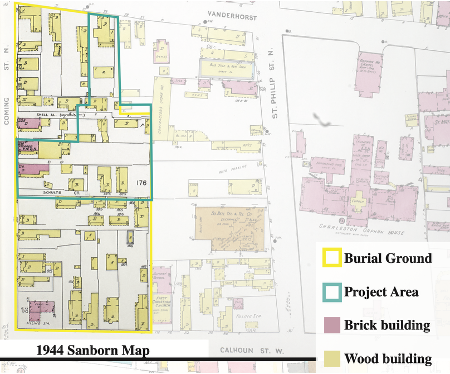
- Historic Research and Geophysical Assessment Report on 106 Coming Street and 99 St. Philip Street by S&ME, Inc.
Phase 2 – Community Engagement (ongoing throughout project)
- Focused listening sessions with specific stakeholder groups
- Public meetings (summer 2025)
- Establishment of the Community Engagement Council
- Community Outreach Forums
Phase 3 – Archaeological Investigation (multi-stage)
Archaeological work will take place in several stages, beginning with non-invasive survey and continuing through monitoring, ground-truthing, and excavation.
- Non-invasive survey (ground-penetrating radar)
- Documentation of existing structure (YWCA)
- Archaeological monitoring will begin at security fencing and silt fencing, through site preparation, and a third round of geophysical survey after the asphalt has been removed (conducted by Terracon).
- Planned pause points for consultation regarding methodology, research design, and ground-truthing locations.
- Targeted archaeological ground-truthing of identified features
- Excavation and documentation
- Ground-penetrating radar (GPR) survey
- A second ground-penetrating radar (GPR) survey was conducted at 106 Coming Street on Feb. 14, 2026. This comes after an initial GPR survey in 2024.
- The GPR survey report has been redacted per No. 6 of the permit conditions of the South Carolina Bureau of Coastal Management, which says: Locational data of human remains will be redacted from all reports until the completion of the project and sensitive information (including photographs of skeletal remains) will not be made publicly available through reports, technical memorandums, or excavation updates.
- The GPR survey maps changes in the upper several feet of soil. These range from hard structures, such as brick foundations, brick-lined wells, and cisterns to much subtler excavations that, in an urban setting such as this, can represent grave shafts, shallow pits, borrow areas, privies or other disturbances.
- Archaeologists would need to excavate to verify any subsoil disturbance.
- A third round of ground-penetrating radar will be conducted by the College’s contracted cultural resource management firm.
Phase 4 – Human Remains Stewardship
If human remains are encountered, they will be documented and protected. Decisions about excavation, analysis, and reinterment will be made in accordance with work plans, regulatory requirements, and advice from the community.
Phase 5 – Memorialization and Interpretation
- Commemoration and memorialization
- Interpretation
How Decisions are Made:
- The project follows applicable state and local regulations and is also informed by national best-practice guidance for burial sites, including ACHP principles.
- Regulatory requirements and approvals (including SHPO review) guide when and how work can proceed.
- The State Historic Preservation Office (SHPO) and the Department of Environmental Services (DES) provides regulatory review and professional guidance but does not independently determine the final outcome of the project.
- The College of Charleston Board of Trustees and administration are responsible for final decisions.
- Recommendations from the CEC, technical experts, and regulatory agencies are reviewed together by the College as part of the decision-making process.
- Key decisions are shared with the CEC during monthly meetings and via email updates.
- Key decisions will also be shared via community outreach forums, listening sessions, and on this website.
What Is Still Being Determined?
While the College has committed to addressing student housing needs on this property, many important questions remain under active review and consultation, including:
- Protocols for treatment of human remains
- Funeral directors engaged in human remains stewardship
- Reinterment approaches and locations
- Memorialization and interpretation strategies
- Public access and commemorative-space design
- How community history and memory will be represented
These issues will continue to evolve as additional information becomes available.
Work Plans
The Archaeology and Cemetery and Commemoration Work Plans outline how archaeological and bioarchaeological investigation at the site will be conducted, including methods for survey, monitoring, excavation, documentation, and the respectful treatment of any human remains that may be encountered. These plans are developed in consultation with regulatory agencies and follow state standards and professional archaeological guidelines.
The Work Plans are separate from construction plans. They guide how the site is studied and cared for before and during any ground disturbance, while construction plans address building design and infrastructure.
Student Housing Plans
The College of Charleston has identified a need for additional on-campus student housing, particularly for first-year students. Providing more housing on campus is intended to support student success and reduce pressure on surrounding neighborhoods.
Approaches to commemoration and interpretation will continue to evolve based on archaeological findings, public input, regulatory requirements, and ongoing consultation. The College of Charleston has stated its commitment to documenting and commemorating the historical significance of the site.
Document Library
- Work plans
- SHPO correspondence
- Terracon Reports
- CEC Meeting summaries
- Community Outreach recordings
- Webinar recordings